
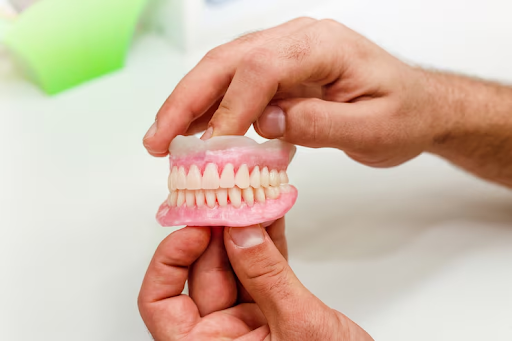
Anyone who has worn removable dentures for a few years knows the small daily compromises that come with them — the clicking sound when eating an apple, the adhesive that needs reapplying by mid-afternoon, the awkward moment of taking them out at night. For patients tired of that routine, full arch implants in Coventry offer a genuinely different approach: teeth that are fixed in place rather than removed and refitted every day.
How the Two Approaches Actually Compare
| Traditional Dentures | Full Arch Implants | |
| Stability | Can shift while eating or speaking | Fixed permanently in the jaw |
| Bone health | Jawbone continues to shrink over time | Implants stimulate and preserve bone |
| Daily care | Removed nightly, cleaned separately | Brushed like natural teeth |
| Adjustment period | Often re-fitted as gums change shape | Stable once healed, minimal refitting |
| Speech | Can affect pronunciation, especially “s” and “th” sounds | Functions much closer to natural teeth |
The bone preservation point is one that surprises a lot of patients. Missing teeth cause the jawbone underneath to gradually resorb, which is why dentures often need relining every few years as the gum shape changes. Implants, by contrast, act similarly to natural tooth roots, sending signals to the bone that help maintain its density.
What the Procedure Actually Involves
A full arch replacement typically uses a small number of strategically placed implant posts — often four to six per jaw — to support an entire arch of prosthetic teeth. This is different from replacing every single tooth individually, which would be far more invasive and costly. The implants are placed surgically into the jawbone, given time to fuse (a process called osseointegration), and then a custom-fitted prosthetic arch is attached. Patients researching this option can find an overview of how full arch implants are planned and placed before ever sitting in the consultation chair.
For patients with sufficient bone density, some clinics can complete this in a single day, giving patients a functional, fixed set of teeth almost immediately, with a final refined prosthetic fitted once healing is complete. Details on the treatment path, from consultation through to placement, are laid out at the practice’s dental implant treatments page for patients weighing up whether they’re a suitable candidate.
Who Tends to Be a Good Candidate
Patients considering this route are usually dealing with extensive tooth loss, failing dentures, or teeth that are beyond saving due to decay or gum disease. Sufficient jawbone density is generally required, though bone grafting can sometimes address shortfalls in patients who’ve lost bone over years of denture wear. A dentist will typically use a CT scan to assess bone volume before recommending a specific implant plan.
Considering the Long-Term Value
The upfront cost of a full arch implant procedure is undeniably higher than a set of dentures, and that’s often the first thing that gives patients pause. But the comparison isn’t quite fair without factoring in the full picture — dentures typically need replacing or relining every five to eight years as the jaw shape changes, adhesives add up as an ongoing cost, and the daily friction of removable teeth is something many patients only fully appreciate the absence of once it’s gone. Viewed over a ten or fifteen year span rather than a single purchase, the numbers — and the daily quality of life — often tell a different story than the sticker price alone suggests.